
How to Write a Policy Memo
A bonus newsletter issue!

I’m often asked by students for guidance on how to write policy memos. This is not a minor request, as we require our policy students to write a lot of memos. But I have avoided providing detailed guidance for a number of reasons. First, creativity research tells us that if you provide too much guidance, suggestions become rules and everything starts to look the same. The tricky part is that it is almost impossible to judge when you’ve hit “too much guidance.” Second, when I have provided examples to students over the years, what I get back are versions of what I’ve done, reinforcing the first concern. Third, no one taught me how to do it, and I figured it out, so there!
Well, in talking to some friends about this recently, most notably Tim Green at Cal State-Fullerton, I started to rethink things. Tim listened patiently to my weariness at providing the same technical advice/corrections on the majority of student memos, then he noted that we can design AI bots to handle the standard technical corrections (which we are doing with his help!). His point really made me think about whether my approach to memo writing had to be rethought: If most feedback is technical in nature, maybe more direct instruction on memo writing would be helpful to my students?
Around the same time, I started to notice the evidence in favor of direct instruction versus discovery learning. I’ve always questioned the value of constructivism in teaching , so I admit that the DI research appealed to me primarily through confirmation bias (i.e., it told me what I wanted to hear!). But now we have so much DI-supporting research that it’s more than me wish-casting. Again, I sat back and thought, “Darn it, I’ve been leery about the value of constructivist/ discovery learning approaches to education for over 30 years … why am I using it on this memo stuff?”
Why, indeed. My approach led to a small group of people becoming skilled writers of policy memos … and many others struggling with it. So we’re trying a new approach in our program, with a focus on the use of AI bots to help with the technical aspects, freeing up my time to focus on content and argumentation when reading student memos. The other strategy is sharing the advice I include below, which will become required reading for all Hopkins education policy students beginning this summer. Feel free to share it with anyone whom you think it could help.
The Art and Science of the Effective Policy Memo
I’ve written a lot of policy memos over the years. When first asked to write one, I thought, “How hard can it be?” The technical aspects are straightforward and intuitive, and I’d read plenty of them. Was I in for a surprise! It took me forever, I second-guessed myself the entire time, and a trusted colleague who read an early draft sent me only one note after reviewing it: “Not your best work.” He was being charitable.
If you’re not used to writing in different formats, or you have written primarily in one format (e.g., academic papers), the transition to policy memos can be tricky. It’s not an academic paper, not a white paper or monograph, not an evaluation report, not a blog post, not an op-ed. Yet it can be pieces of all of those things … or none of them. It’s a fact-based, persuasive essay that should include valuable insights for the reader (see the Addendum for more on this point).
What often confuses new memo writers is that the context for these short policy documents can vary widely. They can be solicited (“Rep. Smith wants to know what the research says on this topic”) or unsolicited (“I want Rep. Smith to know this information”). They can be directed to a specific person or group (a senator, a governor, the chair of a state education committee) or written more broadly (a Dear Colleague letter or helping an executive branch agency staffer write a mandated letter to Congress).
I have found these four basic principles to work for almost every memo:
Keep it brief
Keep it clean
Make it easy to skim and understand
Be informative but not pedantic
Keeping it brief and clean are easy to understand. Anyone requesting a memo doesn’t want to read War and Peace. If they want a longer analysis, they will ask you to write a white paper. That said, there are no hard and fast rules on length – one page is usually too short, four-to-five is usually too long. My colleague Henry Smith, when he was a New Hampshire mayor who helped prep presidential candidates, kept policy memos to 1-3 pages because, as he shared, “I never knew how much time I would get with them.” Make sure it looks clean: No typos, no formatting mistakes, with a professional look and feel.
Making it easy to skim and understand is more of an art than science. If a policymaker requests a memo from you, odds are that they will have 2-3 minutes at most to read it. More to the point, one of their staffers will give it a quick skim to ensure it is worth their boss’ time, then the policymaker will have 2-3 minutes to read it.
As noted above, being concise helps in this regard, but there’s more to it than just length. For example, I often state my biggest take-away point early in the memo, if not the very first line. That creates a strong hook that pulls the reader into the piece. Keeping the text as jargon-free as possible also helps – perhaps the reader knows all the acronyms and academic terms, but often they do not.
A good visual or two goes a long way to making the memo look inviting. If you find yourself sharing lots of statistics in a dense paragraph, a figure or table is probably a better way to convey the information.
Being informative yet not pedantic can be challenging. It all comes down to the knowledge level of your audience. If you are asked to write a memo and don’t know the intended recipient’s knowledge level on the topic, it’s appropriate to ask about the level of background information needed in the memo. If the memo is unsolicited, you’ll need to make a judgment call. One way to hedge on this is to link to background material in the memo without taking the space to rehash it. For example, if you are writing a memo on a state’s accountability system results, you could link to information on the system when you describe the purpose of the memo without having to include a long, detailed description in the introduction.
As is always the case in persuasive writing, your goal is to provide insights. For a policy memo, that comes down to identifying trends, ways of considering the available data and perspectives, and recommendations that are unique and useful to the reader. Perhaps you come up with a metaphor or personal example that helps the reader understand the issue at hand (and, even better, helps them explain it to others), maybe you create a data visualization that provides a different lens on the issue. Whenever possible, provide insights about how the opposition to the policy thinks about the issue. Whatever your strategy, focus on adding value to the reader’s understanding. Another way to think about it: What two or three talking points can you give the policymaker to share during hearings, media hits, or hallway conversations with colleagues?
Of course, the temptation to overthink things and go too deep into the weeds is always sitting on the edge of your brain. You can be too informative in a policy memo, which weirdly makes the memo less informative – if someone compliments your dish at a dinner party and asks how you made it, you wouldn’t start with, “Interestingly, wheat was first cultivated in the Middle East at least 10,000 years ago. Scientists believe it may be a hybrid of a number of ancient grains ….” Your friend would stop listening before you got to the end of the first sentence! Same thing with short-form persuasive essays: It doesn’t need to include every detail on a specific policy topic, just the most relevant pieces of information for your audience.
Bringing It All Together
A U.S. senator’s education aide once called me out of the blue to request a memo on their state’s recently released testing results. The senator was meeting with the governor the following weekend and wanted to know the high points of the results. The senator began his political career on a school board, and he knew schools well enough to not need much background information.
The first draft came together quickly but was boring. Too obvious and straightforward, it read like a more detailed version of the state department of education’s press release on the results. How could I present the data in a new way, one that was quick to understand and memorable?
I poured over the results again, then something caught my eye – the passing rate for Black boys was very low. Of course, I’d noted that in the first draft, but how to land that punch a little harder? I dug into the subgroup data a little more and found my unique point: The passing rate for upper-income, Black boys without learning disabilities was similar to or lower than the passing rate for lower-income, Caucasian boys with learning disabilities. I mean, holy smokes, right? I made a figure and mentioned this point in the memo. I had a colleague read it for me, proofread it one more time, and sent it off to the aide.
The aide had already replied when I opened my email the next morning: The senator was so surprised by that point that he found it impossible to believe. They asked me to check the data again, assuming I had it wrong! That was a fair request, and I pulled the data again, confirmed that it was correct, and conveyed this to the aide.
That was only my first or second memo for the senator, but I was soon regularly writing memos for him. He wanted unique perspectives that helped him understand the issue at hand, not a quick summary that he could have gotten from anyone. This is especially important in an age of AI, where staffers can ask AI to write quick summaries of key issues in an instant. As you write your policy memos, always keep this key question in mind: What innovation am I bringing to the analysis?
Some Final Recommendations
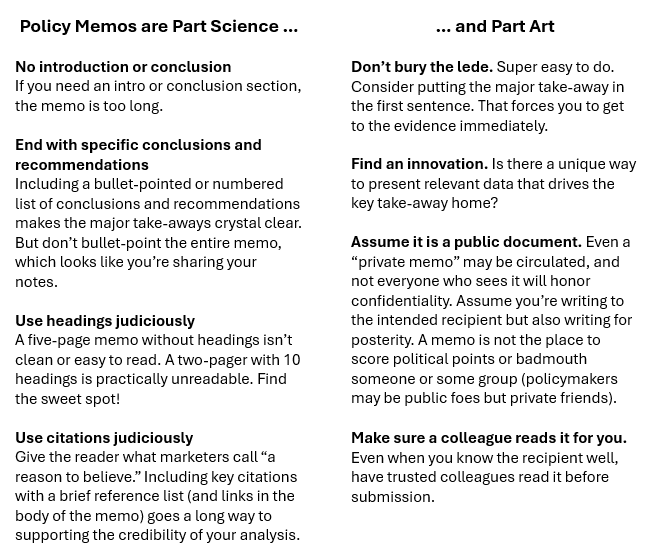
I’ve often advised students and colleagues to think of policy memo-writing as both an art and a science. Clear rules and guidelines exist for technical aspects of the memo, and those are readily teachable and learnable. The art of the policy memo is a tougher nut to crack: Some people get it immediately; others need to work to get the right tone and flow. But like all arts, everyone gets better with practice. Consider the following recommendations:
Let me close with some advice that I often share with people who ask me how to be a good presenter: If you want to get better at something, get better at it. That’s a cheeky way of saying that you need to seek out advice and feedback and practice, practice, practice. Want to become a better speaker, better at giving testimony at a legislative hearing, better at writing policy briefs and memos? Then seek out opportunities to speak, testify, and write – and get honest feedback about how you can improve. There are no shortcuts. Strive to get better with each opportunity, and you’ll quickly find yourself mastering both the science and art of policy communication.
Jonathan Plucker is a Professor of Education at the Johns Hopkins School of Education, where he directs the Master’s Program in Education Policy. He has written both confidential and public memos for federal and state policymakers for over 20 years. His first attempts at policy talks, providing legislative testimony, and writing policy memos were cringe-worthy. If he can do it, you can do it.
Special thanks to Henry Smith, Richard Lofton, and Jodi Miller, who all provided helpful suggestions.
Addendum!
One interesting reaction to this piece has been questions about the differences and similarities among the various publication types. The following table is an attempt to provide a general overview of the various ways to share policy information. It is not definitive, and others would almost certainly describe things differently. But it provides a way to think about the various vehicles for communicating about policy.
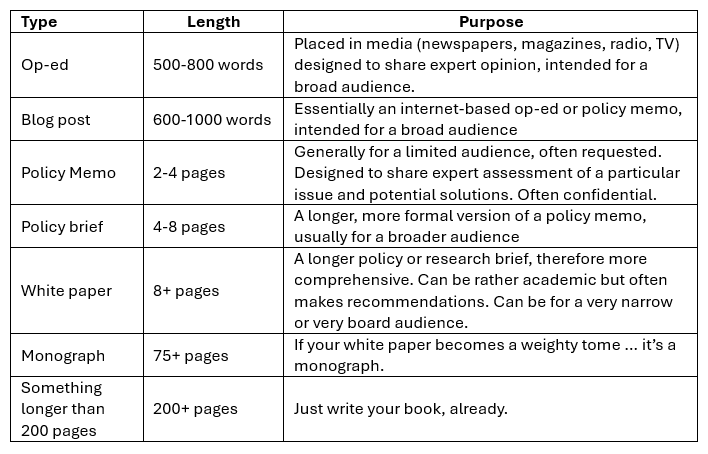
Op-eds, blog posts, and policy memos can be quick to produce and share. Policy briefs, white papers, and monographs are obviously longer-term affairs due to their length and comprehensiveness.
There is no one right way to communicate about policy; we usually use an “all of the above” approach, especially over the long haul. The policy memo and policy brief are the foundations of policy communication, but being able to write in all of the forms above is a valuable skill.
Excellent advice on preparing a policy memo. Looking at your table o the length of publications reminds me of a conversation we've recently had at work. What do you think about limiting emails to 100 words?
And where was this in 2023!?!